Website Design for Contractors: Build a Faster Path to More Booked Jobs
A contractor’s website does not need to win design awards. It needs to help a busy homeowner make a decision fast.
That sounds obvious, but a lot of websites for contractors still miss the mark. They look decent on a desktop monitor, then fall apart on a phone. They bury the phone number. They ask visitors to hunt for service areas. They open with a giant hero image and almost no useful information. Some are so heavy that a customer taps the page, waits, gets impatient, and goes back to search results to call the next the Scalable Websites team company.
That is the real standard for contractor website design. Not whether the homepage feels trendy, but whether it shortens the path from interest to contact.
Google’s own guidance lines up with what many of us have seen in practice for years. Keep important information above the fold. Use simple navigation. Avoid intrusive pop-ups. Make mobile pages load fast. Reduce the number of steps it takes for someone to call, message, or request a quote. If you work in roofing, HVAC, plumbing, electrical, or any other home service category, that advice is not abstract. It is directly tied to whether you book jobs.
Your website is part showroom, part dispatcher
When people search for a contractor, they usually are not in a browsing mood. They are trying to solve a problem. Maybe the AC is out. Maybe there is water under the sink. Maybe a roof leak just showed up after a storm. Even for less urgent projects, the pattern is similar. The visitor wants reassurance, proof, and a quick next step.
That is why home service website design tends to work best when it behaves more like a dispatcher than a brochure. The site should immediately answer the practical questions a homeowner has in the first few seconds.
Do you serve my area?
What exactly do you do?
How do I contact you right now?
Can I trust you?
If those answers are hard to find, the design is already working against the business.
This is true across specialties. Roofing website design, HVAC website design, plumbing website design, and electrician website design all have their own visual cues and service details, but the buying behavior is remarkably similar. People search, compare quickly, scan for trust, and act on the easiest option that feels legitimate.
What should be visible before anyone scrolls
Above the fold matters more for contractors than for many other industries because the visitor often arrives with a specific task in mind. Google explicitly recommends keeping key information visible early, and that advice deserves more respect than it usually gets.
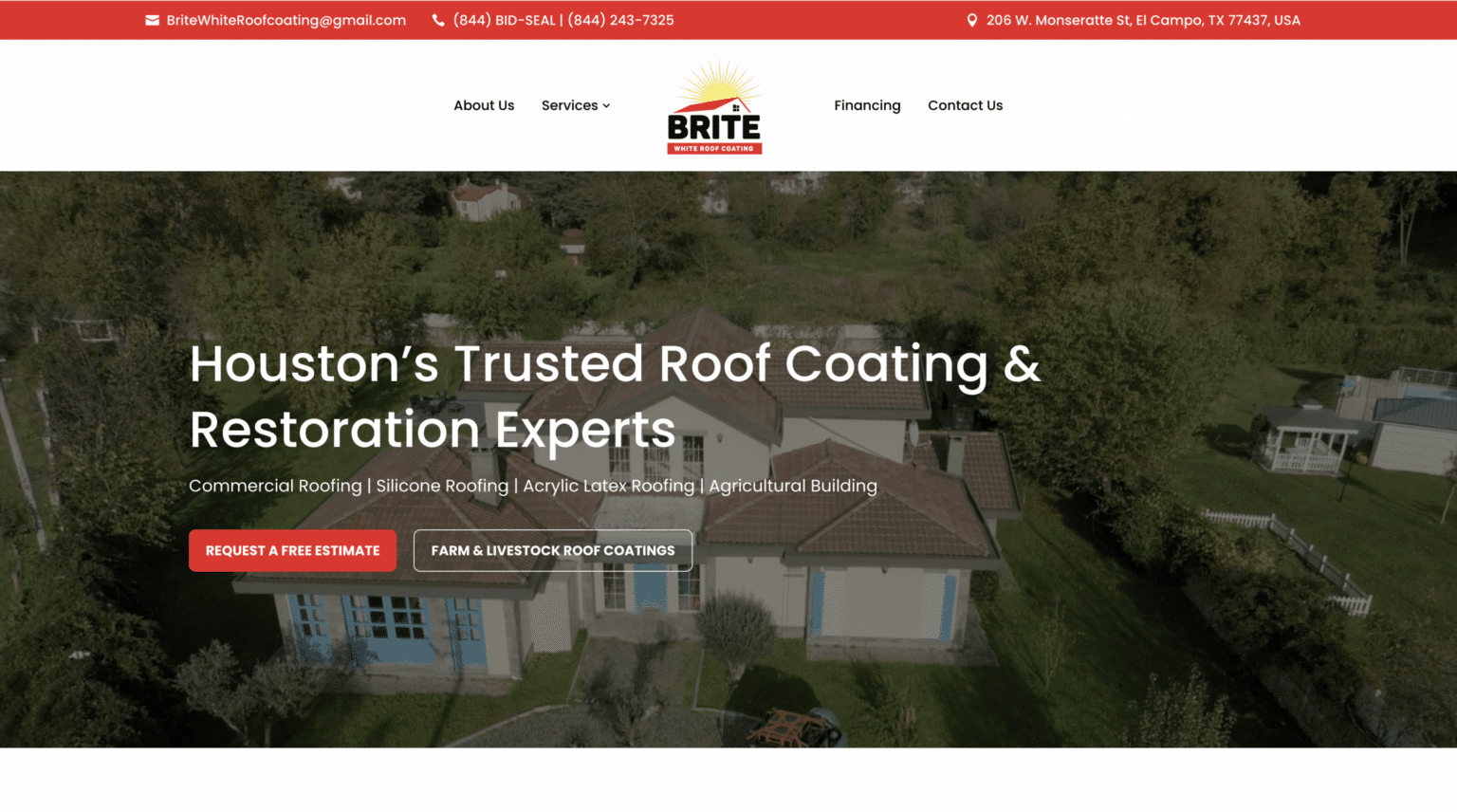
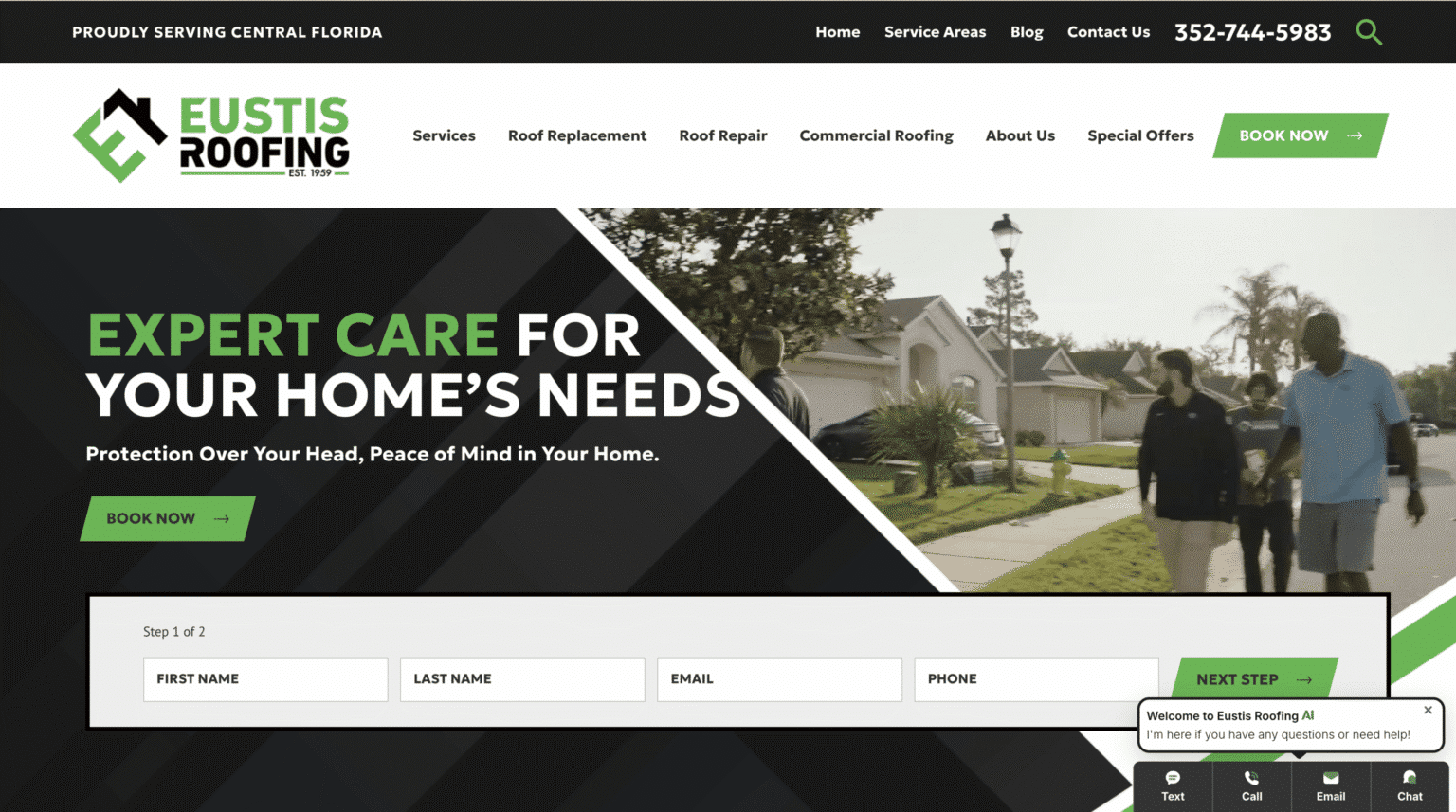
A strong homepage opening does not need much. It needs clarity. The company name, what you do, where you work, and a direct path to contact. On mobile, that usually means a call button that is impossible to miss, plus a short quote form or message option that does not ask for a life story.
A good opening section might simply state that you provide residential plumbing services in a set of service areas, followed by a clear phone number and a quote request button. For an HVAC company, it might highlight repair and replacement services, emergency availability if applicable, and the areas served. For an electrician, it might present core residential services and an invitation to call or request service.
None of that is glamorous. It is effective.
Many contractor sites overcomplicate this section with rotating sliders, vague taglines, and generic stock photos. The problem is not just style. Those choices delay action. If a homeowner has to decode what the business actually offers, the site is doing extra work for no benefit.
Mobile design is not a feature, it is the default
A lot of contractor websites are still reviewed on a desktop first, even though many searches happen on phones. Google has been clear on this point for years. Responsive design and mobile-friendly pages are important because users often discover local service businesses on mobile devices. Google also uses mobile-first indexing, which means mobile page quality is not a side issue for search visibility.
In plain terms, if your mobile site is slow, inconsistent, hard to crawl, or missing content that appears on desktop, you can lose both visitors and visibility.
That affects almost every decision in website design for contractors. The navigation needs to be short and easy to tap. Text needs to be readable without zooming. Buttons need enough size and spacing to avoid annoying mis-taps. Forms need to ask for only the information required to start the conversation. And every page needs to load without making the user wait through oversized images, clunky scripts, or pop-ups that cover the screen.
I have seen contractors spend a lot of money on visual flourishes that vanish the moment a real user visits from a phone in a driveway, in a warehouse, or on a lunch break. A mobile visitor does not care how clever the animation is. They care whether they can call in two taps.
Fast pages win more than design debates
Page speed is one of those topics that gets discussed in technical language, but the business impact is simple. Slow pages lose visitors.
Google says as much in its mobile guidance. If pages take too long to load, users leave. If actions require too many steps, users drop off. For lead generation websites for contractors, that is money leaking out of the system.
The practical fix is usually not mysterious. Keep page builds lean. Use appropriately sized images. Avoid stacking unnecessary widgets and third-party tools. Be careful with heavy pop-ups. A contractor site does not need the digital equivalent of a showroom full of blinking lights. It needs to load quickly and get out of the customer’s way.
This is one place where a contractor web design company can earn its keep, but only if it understands the trade. Some agencies design as if every website exists to impress other marketers. Contractors need a site that serves the homeowner first.
The shortest path to a lead usually looks boring
That is not an insult. It is a compliment.
Lead generation websites for contractors often perform best when they make the next step feel effortless. Google’s recommendations support this approach directly: reduce friction, keep actions simple, and make mobile contact easy. For many contractors, the highest-value actions are still calling, messaging, or filling out a short estimate form.
Here are the elements that usually matter most:
- A prominent click-to-call button on mobile.
- A short form with only essential fields.
- Clear service area information.
- Straightforward service pages.
- A visible messaging option for after-hours inquiries.
That fifth point deserves more attention than it gets. Google’s business communication guidance highlights messaging and chat as mobile-friendly ways for customers to start conversations. Google’s Local Services guidance also notes that enabling messaging or booking can increase the likelihood of receiving leads when the phone is not answered.
For contractors, that matters. Calls get missed. Crews are in attics, on roofs, in crawl spaces, or driving between jobs. A messaging option does not replace the phone, but it gives a homeowner another path when immediate calling does not work.
The key is to keep it practical. Messaging should support contact, not distract from it.
Trust is built with specifics, not adjectives
A lot of contractor sites try to sound trustworthy by saying they are dependable, professional, or committed to quality. Those words are fine, but they do not carry much weight on their own.
Trust comes from specifics.
Real photos help. Google encourages photos for Local Services Ads and reviews them for quality before they are published. That tells you something useful. Real project imagery matters because it gives homeowners a grounded sense of the work. The same logic applies on your site. Before and after images, team photos, trucks, jobsite photos, and clean project galleries all do more than generic stock images.
Reviews matter for the same reason. Google Business Profile includes a reviews feature, and Google encourages businesses to read and reply to reviews. If your website includes customer reviews or testimonials, it should feel connected to your real public reputation, not like a disconnected marketing exercise. A homeowner comparing websites for contractors will often scan reviews before reading much of anything else.
The strongest trust signals also tend to be the plainest. Service area details. Business hours. Accurate categories and services. Clear contact information. These details are not flashy, but they reduce uncertainty. And uncertainty is what makes people hesitate.
Local SEO for contractors starts with consistency
Local SEO for contractors often gets sold as a technical mystery. The basics are less dramatic.
Google Business Profile gives service-area businesses a way to define service areas, choose the correct business category, and display the website on the profile. Those basics help the business appear more relevant in local search. For contractor websites, that creates an important connection between the website and the wider local search presence.
If the site says one thing about services or locations and the profile suggests something else, trust drops. If the profile is clear but the site buries service areas three clicks deep, conversion drops. If the site looks polished but the profile lacks useful information, visibility and response quality can suffer.
A smart contractor website design approach treats the website and the business profile as part of the same local system. Your key services should align. Your service area should be easy to understand. Your contact details should be accurate. Your photos should look like they belong to the same business.
That is not advanced SEO. It is disciplined local marketing.
Service pages should match how customers think
One of the most common mistakes in home service website design is collapsing everything into a vague “services” page. That makes the site easier to build, but harder to use.
Customers do not usually search in generalities. They search for roofing repair, AC replacement, drain cleaning, panel upgrades, and similar specific needs. Even when a homeowner starts on the homepage, they still want quick confirmation that you handle their exact problem.
This is why roofing website design often benefits from separate pages for common service categories, and why HVAC website design, plumbing website design, and electrician website design usually do too. Not because every site needs dozens of pages, but because clarity matters.
A page about plumbing services should make it easy to understand what kind of plumbing work the company actually takes on. An electrician service page should not force users to decode broad language if they are trying to confirm that the company handles the kind of work they need. The same applies to roofing and HVAC. Precision reduces wasted calls and increases qualified leads.
The trick is to avoid overbuilding. Some contractors create endless thin pages with almost no useful content. That can make the site harder to maintain and weaker for users. Fewer, stronger pages are often better than a bloated structure full of repetition.
Navigation should feel obvious to a tired homeowner
Good navigation is almost invisible. People should not need to think about it.
Google recommends simple navigation, and for contractor sites that usually means resisting the urge to build a giant menu. A homeowner does not need a maze. They need a quick route to the service they need, the areas you serve, your reviews or project photos, and your contact page.
A simple structure often works best. Home, key service pages, service area information if useful, about or trust-building content, and contact. That is enough for many businesses.
The more urgent the service category, the more important it is that contact options stay visible everywhere. Plumbing website design and HVAC website design in particular often benefit from keeping a phone button in plain sight on mobile at all times. Roofing can be a little different because some projects are less urgent, but the same principle still holds. Make reaching out easy.
Real photos do more work than fancy copy
Contractors usually underestimate how much homeowners study photos.
Google’s guidance around Local Services Ads photos, including quality review before publication, reflects something obvious from the customer side: visuals shape trust. People want evidence that you are a real local business doing real work.
That does not mean every site needs a dramatic gallery. It means the images should support decision-making. Show clean, relevant examples. Use job photos that align with the actual services you want to sell. If your best work is high-end electrical panel upgrades, do not let the site be dominated by unrelated stock imagery. If your roofing company has strong before and after storm restoration photos, use them with purpose. If your HVAC business has clean install shots and team photos, those often outperform generic air conditioner graphics.
Photos also help bridge the gap between the website and the business profile. When a homeowner sees similar branding, similar crews, and similar project standards in both places, the business feels more legitimate.
Messaging, after-hours leads, and the jobs you miss when nobody answers
There is a quiet revenue problem in many service businesses. The website works, the profile works, leads come in, and then the call gets missed.
Google’s Local Services information notes that enabling messaging or booking can improve the chance of receiving leads when the phone is not answered. That is a practical point, not a theoretical one. Contractors are busy. Some shops have office staff. Many do not. A missed call at 7:20 p.m. Might be a homeowner who ends up hiring someone else by 7:35.
Adding a messaging option can help close that gap, especially on mobile. It gives the customer a fallback when they cannot or do not want to call. It also fits how many people now prefer to start low-pressure service inquiries.
This does not mean every contractor needs complicated chat systems. It means the site should offer at least one low-friction contact option beyond the phone. For some businesses that is a short form. For others it is messaging. The right choice depends on how the business actually handles inbound leads.
That is one of the trade-offs a good contractor web design company should discuss honestly. A contact tool is only valuable if someone responds.
What contractor website cost really depends on
Contractor website cost is one of the hardest topics to discuss cleanly because pricing varies a lot, and broad numbers are easy to misuse. Without reliable universal benchmarks, the more honest answer is that cost depends on scope, support model, and how much ongoing help the business needs.
A basic site with a few service pages, standard contact features, and a clean mobile build will cost differently than a site with larger content needs, more service-area targeting, ongoing updates, and hands-on support. Some providers sell one-time builds. Others offer monthly plans that bundle hosting, security, and updates.
One public example is Scalable Websites, a Houston company that describes itself as offering monthly website subscriptions for home service contractors, with hosting, security, unlimited updates, and a dedicated project manager. That is useful as a model of how some contractor web design company offers are structured, not as a claim that one pricing format is always better.
For some contractors, a monthly service makes sense because they do not want to manage updates, hosting, and fixes. For others, ownership and a one-time project may feel more comfortable. The important thing is to understand what is actually included, especially support after launch. A cheap site that becomes difficult to update can cost more over time in missed opportunities and accumulated fixes.
Before signing anything, make sure you understand these points:
- What pages and features are included at launch.
- Whether hosting, security, and updates are included.
- How fast changes are handled after the site goes live.
- Who writes and edits the website content.
- Whether the site is being designed with mobile speed and local search basics in mind.
Those questions usually reveal more than the sticker price alone.
Different trades, same principles
The visual style of roofing website design may differ from HVAC website design, and both may differ from plumbing website design or electrician website design. Roofing sites often lean on project photography. HVAC sites often need to communicate service urgency clearly. Plumbing and electrical sites often benefit from especially strong contact paths because many jobs begin with an immediate problem.
Still, the principles stay consistent.
Make the mobile experience smooth. Put key contact information where it cannot be missed. Use real photos when possible. Keep the navigation simple. Align the site with the business profile and service area. Offer a low-friction path to start the conversation. Build pages that match how real customers search and decide.
That is what effective website design for contractors looks like in practice.
Not louder. Not busier. Not more complicated.
Just easier to trust, easier to use, and faster to turn into booked work.
About Scalable Websites
Scalable Websites builds professionally designed, AI-powered websites for roofers, HVAC companies, plumbers, electricians, remodelers and other home service contractors, with hosting, security, unlimited updates and lead capture included in one monthly plan.
396 Mallorn Lane, Montgomery, TX 77316
Phone: (832) 979-2478
Website: scalablewebsites.com
About Scalable Websites
Scalable Websites builds professionally designed, AI-powered websites for roofers, HVAC companies, plumbers, electricians, remodelers and other home service contractors, with hosting, security, unlimited updates and lead capture included in one monthly plan.
Houston, TX · Serving contractors nationwide
Phone: (832) 979-2478
Website: scalablewebsites.com